
What Is ICF Construction?
What Is ICF?
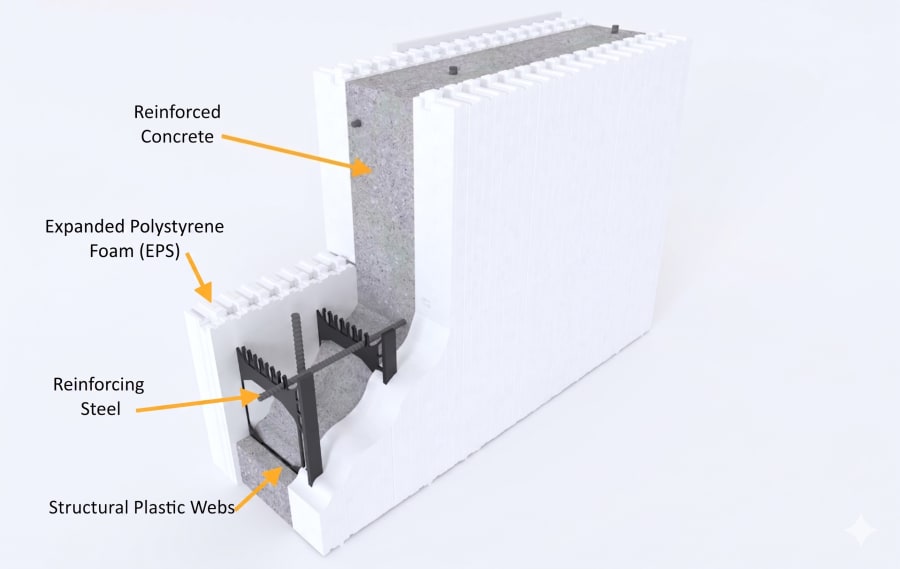
Insulated Concrete Form (ICF) construction uses interlocking foam blocks filled with reinforced concrete to create walls that are dramatically stronger, more energy-efficient, and more durable than traditional wood-frame construction.
Unlike wood framing — which is vulnerable to moisture, rot, pests, and wind damage — ICF walls are solid concrete surrounded by continuous insulation. Think of a wood-frame wall as a screen door and an ICF wall as a thermos. Same concept, completely different performance.
ICF has been the standard in commercial construction for decades. Rusot USA brings that same technology to residential and specialty projects across South Texas — where the climate makes ICF's advantages even more valuable.
How ICF Compares to Common Building Methods in South Texas
The RGV has three common wall systems — wood frame, wood frame with Hebel panels, and CMU block. Here's how ICF stacks up against all of them.
Energy Efficiency: Cut Bills by 40–60%
ICF walls achieve R-values of 40–50 compared to R-13 to R-21 for conventional construction. In South Texas, where air conditioning runs 8–10 months per year, this translates to real, measurable savings every single month.
Structural Strength: Built for 200+ mph Winds
ICF walls are solid reinforced concrete. They meet and exceed hurricane and tornado resistance standards — providing a level of protection no traditional building method can match.
Sound Isolation: 50% Quieter Inside
The concrete mass and continuous insulation of ICF walls dramatically reduce sound transmission — ideal for homes near busy roads or commercial areas, and for any building where privacy matters.
Fire Resistance: Up to 4-Hour Rating
ICF walls carry fire ratings of up to 4 hours compared to 1 hour for standard construction. This can lower insurance premiums and provides critical protection for families and businesses.
Insurance Savings: Lower Premiums Year After Year
The disaster-resistance and fire ratings of ICF construction often qualify homeowners and business owners for significantly lower insurance premiums — creating ongoing savings beyond energy bills.
Long-Term Value: Built to Last Generations
ICF structures have a design life of 100+ years. They don't rot, warp, expand with humidity, or attract pests. Long-term maintenance costs are a fraction of traditional construction equivalents.
ICF Systems and Tools We Build With
Rusot USA builds with ICF systems from the industry's most trusted manufacturers and uses professional-grade tools to plan and price every project. Each system has been engineered, tested, and code-approved — and we choose the right one for your project's structural and design needs.
Nudura
Nudura is one of North America's most widely used ICF wall systems, known for fast installation and proven hurricane and tornado performance. We use Nudura on residential and commercial projects where speed and strength matter.
Visit NuduraLogix ICF
Logix ICF delivers high R-values, robust structural performance, and the flexibility we need for complex residential and commercial walls. Their PRO and Platinum forms are a staple in many of our builds.
Visit Logix ICFInsuldeck
Insuldeck is a precast insulated concrete decking system we use for floors and roofs — pairing with ICF walls to deliver a fully insulated, monolithic, hurricane-resistant building envelope.
Visit InsuldeckPlanSwift
PlanSwift is the industry-standard takeoff and estimating software we use to deliver precise, transparent project quotes. Every estimate starts with measured calculations from your actual plans — so the price you see is grounded in the same data we'd use to build.
Visit PlanSwift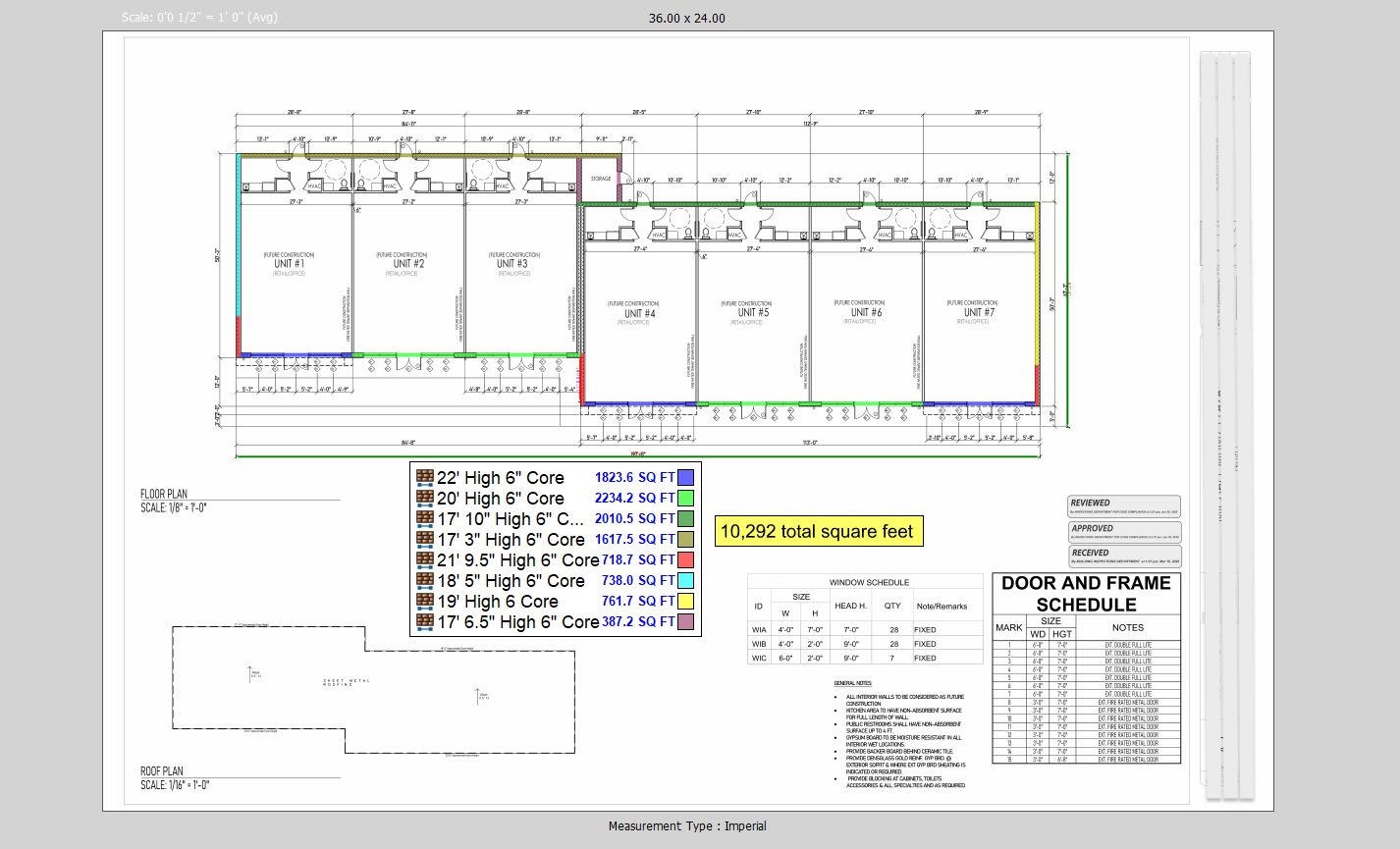
Example PlanSwift takeoff — Commercial Plaza in Harlingen, TX
Technical Resources & Documentation
Clients often want to dig deeper into the engineering and energy performance behind ICF. Below are technical bulletins, design references, and industry resources from leading industry sources — the same documents we reference when planning a project.
Performance & Specifications
Logix Total R-Value Technical Bulletin
Lab-verified R-value breakdown for Logix wall assemblies, including Intertek test report references.
Logix Design Manual (USA)
Comprehensive design and engineering reference for the full Logix ICF system.
Nudura R-Value Inserts
Technical data sheet for Nudura's R-value insert system, including thermal performance specifications for Nudura wall assemblies.
Energy Efficiency & Industry Standards
DOE Zero Energy Ready Home Program
Federal program defining the next generation of energy-efficient new homes — ICF builds easily meet these standards.
External LinkENERGY STAR Certified New Homes
Industry-standard certification for high-performance, energy-efficient homes.
External LinkICFMA: ICF Manufacturers Association
The trade body for ICF manufacturers — additional industry research, standards, and resources.
External LinkThe Real Numbers: 2,500 sq ft Home in South Texas
| Comparison | Wood Frame | Wood Frame + Hebel | CMU Block | ICF |
|---|---|---|---|---|
| Monthly Energy Bill (summer) | ~$380 | ~$300 | ~$270 | ~$160 |
| Annual Energy Savings vs. Wood Frame | Baseline | ~$960 | ~$1,320 | ~$2,640 |
| Insurance Premium (est.) | ~$3,200/yr | ~$3,000/yr | ~$2,750/yr | ~$2,400/yr |
| 10-Year Total Savings vs. Wood Frame | Baseline | ~$11,600 | ~$16,700 | ~$34,400 |
| Wind Resistance Rating | ~110 mph | ~130 mph | ~140 mph | 200+ mph |
| Construction Cost Premium | Baseline | ~3–5% more | ~8–12% more | ~8–15% more |
*All figures are estimates based on regional averages for South Texas residential construction. Energy costs reflect summer cooling loads typical of the Rio Grande Valley. Hebel column reflects wood frame structure with AAC panel exterior cladding and stucco finish, common in the RGV. CMU column reflects standard 8" concrete masonry unit construction with basic insulation. Actual results vary by project design, site conditions, materials used, and utility rates. Consult a licensed contractor and energy auditor for project-specific projections.
The Real Numbers: 5,000 sq ft Commercial Building — RGV
| Comparison | Wood Frame | Wood Frame + Hebel | CMU Block | ICF |
|---|---|---|---|---|
| Monthly Energy Bill | ~$1,100 | ~$880 | ~$800 | ~$480 |
| Annual Energy Savings vs. Wood Frame | Baseline | ~$2,640 | ~$3,600 | ~$7,440 |
| Insurance Premium | ~$12,000/yr | ~$10,800/yr | ~$10,000/yr | ~$8,500/yr |
| 10-Year Total Savings vs. Wood Frame | Baseline | ~$27,600 | ~$39,600 | ~$108,400 |
| Structural Wind Rating | Standard code | ~130 mph rated | ~140 mph rated | 200+ mph rated |
*Commercial estimates based on South Texas regional averages. Figures are projections for comparison purposes only and are not a guarantee of savings or performance. Actual results vary by building design, occupancy, mechanical systems, and local conditions.